The Solution
Let Texans Do Texas
Replace the federal government’s destructive and unnecessary border barrier plans with a permanent, federally financed, locally administered approach to border security tailored to the Big Bend region.
$2 BillionPermanent Trust for Big Bend Region Border Security. Principal stays intact; only investment income funds operations.
7 CountiesHudspeth, Culberson, Jeff Davis, Presidio, Brewster, Terrell, and western Val Verde.
Fort Quitman to AmistadThe stretch of the Rio Grande the plan covers.
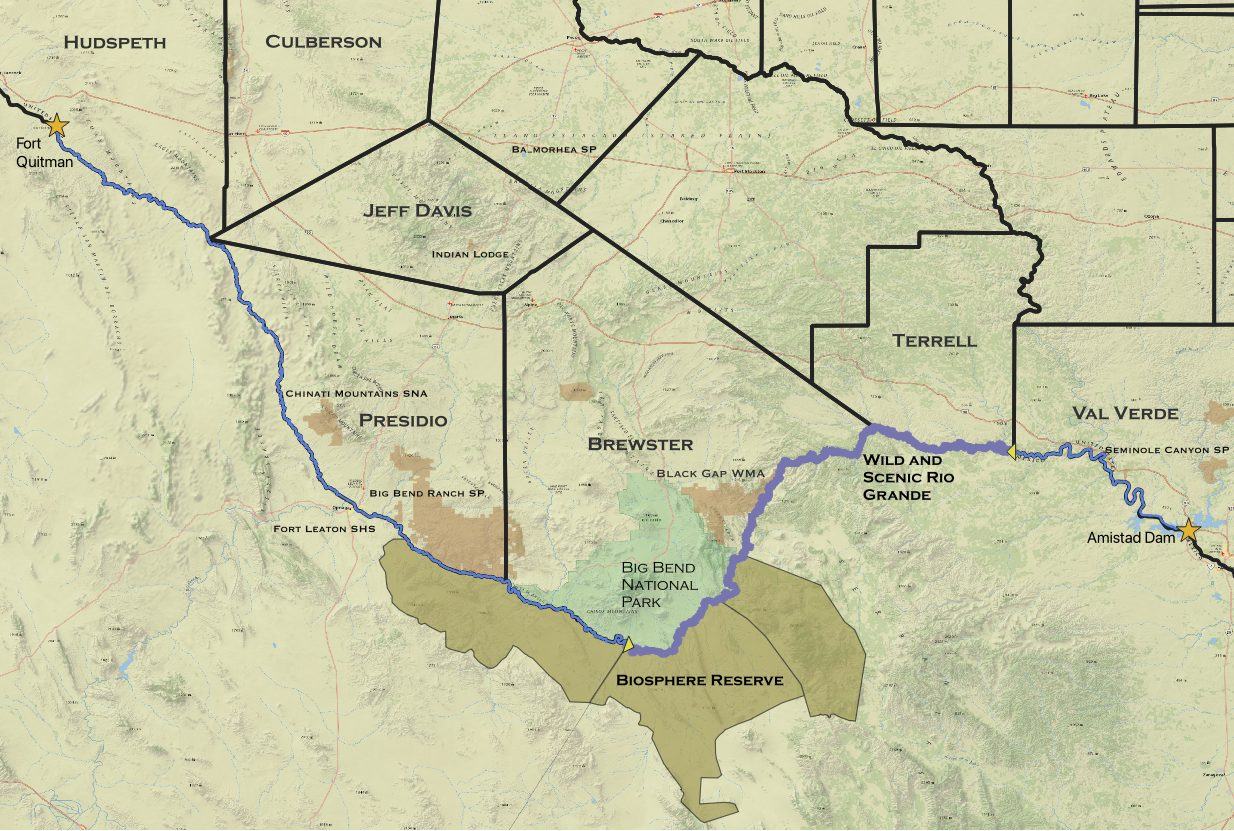
Map prepared by David W. Keller using QGIS. Basemap: Esri National Geographic World Map. Additional geographic data from the Texas Natural Resources Information System (TNRIS) and publicly available sources.
The Plan Calls for Three Actions
1
Pause construction immediately
Congress imposes a temporary moratorium on barrier construction and related ground-disturbing work in the Big Bend while federal, state, and local officials develop the alternative. CBP provides location-specific information on documented border-security threats to help ensure the new strategy addresses actual conditions on the ground.
2
Redirect funds to a permanent trust
Congress halts the Big Bend barrier projects, terminates the contracts, and redirects $2 billion in federal border-security funding to establish the Permanent Trust for Big Bend Region Border Security (the Trust).
3
Put Texans and local leaders in charge
The Trust supports county governments and locally elected sheriffs, with substantial participation by affected landowners, under an independent Texas governing board.
What the Trust Can Fund
Counties identify needs with their elected sheriffs and affected landowners, then apply for funding. Projects are chosen by demonstrated local need and cost-effectiveness. Data is reported to the public.
- Law enforcement
- Additional deputies, patrols, overtime, and small stations
- Technology
- Low-profile surveillance equipment and communications systems
- Transportation
- Patrol vehicles, boats, aircraft, helicopters, and horses
- Infrastructure
- County road improvements, outgoing border trade screening, security equipment
- Emergency services
- Medical response, flood mitigation, appropriate conservation projects
- Cooperative operations
- Joint efforts with neighboring counties, parks, law enforcement, and appropriate Mexican authorities
PROHIBITED USES. The Trust may not be used for a border wall or other large scale border barrier infrastructure, eminent domain proceedings, or new roads or fences.
Additional Protection: Wilderness for Big Bend National Park
Bulldozing in the Santa Elena Canyon and Mariscal Mountain areas of Big Bend National Park in 2026 showed how vulnerable one of America’s most treasured national parks is to large-scale federal construction.
In 1978, the National Park Service recommended that Congress designate 538,250 acres of the park as wilderness. Nearly five decades later, Congress has yet to act. LTDT encourages Congress to finish this long-standing work by establishing statutory wilderness protection for the park’s qualifying undeveloped lands, while maintaining existing public roads, developed areas, and recreational access. The Rio Grande itself would remain outside the designation.
Wilderness designation is not a prerequisite for LTDT, but it would add an important layer of statutory protection against future destructive development.
For more information, see Keep Big Bend Wild.
538,250 acresof Big Bend National Park recommended for wilderness by the National Park Service in 1978. Congress has not yet acted.
Frequently Asked Questions
From the LTDT FAQ dated October 22, 2026.
1What is Let Texans Do Texas, and why was it created?
Let Texans Do Texas (LTDT) is a registered Texas nonprofit created in response to outsized federal border wall plans in the Big Bend region. LTDT seeks lasting local, state, and federal solutions that protect the Big Bend region while addressing legitimate border security needs.
2How would LTDT impact existing projects?
LTDT would stop funding and authorization for the current physical border barrier construction. As proposed, future border security in the Big Bend region would be coordinated and implemented through a board established by the Texas Legislature; the board would be composed of private property owners, current and former elected officials and various federal officers.
3Why is LTDT important?
LTDT offers a practical alternative to federal border wall construction and related infrastructure. It recognizes that border security is a federal responsibility, but protecting the Big Bend region is also a Texas priority. In addition, effective border security is unreachable without local input to tailor tactics to local terrain and conditions.
Texas taxpayers, local communities, and private landowners have invested generations of resources in preserving this unique region. They deserve a meaningful voice in decisions affecting its future.
4What does LTDT propose?
LTDT proposes a permanent, locally driven border security strategy supported by a $2 billion trust fund capitalized with federal resources in lieu of border wall construction.
Rather than relying on the current large-scale, destructive, “dictated-from-DC” federal construction approach, LTDT would empower county governments, elected sheriffs, and private landowners to develop security solutions appropriate to the region’s actual security needs, geography, communities, and conservation priorities.
5How will local communities and private property owners be involved?
Local participation is central to LTDT.
County governments and elected sheriffs would work directly with affected private property owners to identify security needs and develop strategic plans. Landowners would also have representation in the state-level process responsible for overseeing the program.
This approach would ensure that those most directly affected by border security decisions have a meaningful role in shaping them.
6Why does LTDT focus on border security?
The primary focus of LTDT is to permanently stop border wall construction (and related infrastructure). The secondary purpose is to transform our local county government security apparatus to ensure it never happens again. If local governments are not successful, the federal government will come back.
Border security is a national priority, but policies developed far from the Big Bend often fail to reflect local conditions.
LTDT seeks to replace one-size-fits-all federal solutions with practical, locally developed security strategies that protect communities, private property, and the region’s unique landscape.
7How will LTDT be funded?
LTDT proposes establishing the Permanent Trust for Big Bend Region Border Security (the Trust), capitalized with $2 billion in federal funding in lieu of constructing a border wall and related infrastructure in the Big Bend region.
The Trust would provide a permanent source of financial support for locally directed border security. Only interest and investment earnings would be available for expenditure, preserving the $2 billion principal for future generations.
This approach would redirect federal resources from border wall construction toward a lasting, Texas-administered security and infrastructure strategy that protects local communities, private property, and the region’s unique landscape.
8Who would control the Trust Fund?
The Trust would be governed by an independent Texas board led by the Texas Secretary of State.
The board would include substantial representation from the Big Bend region, including local governments, law enforcement, private landowners, and other appropriate experienced state and regional interests.
Administrative support could be provided through the Governor’s Office of Trusteed Programs.
9How would Trust Fund money be distributed?
Funding would go directly to eligible county governments or interlocal organizations based on locally developed border security plans.
Counties would identify their needs in consultation with elected sheriffs and affected landowners, then submit funding proposals for review and approval.
Proceeds (grants) from the Trust would not be distributed directly to individual property owners, federal agencies, or state agencies (except by local instigation).
10What could the Trust Fund pay for?
The Trust could support a broad range of locally directed security activities, including:
- Law enforcement: Additional deputies, patrols, overtime, and small stations.
- Technology: Low-profile surveillance equipment and communications systems.
- Transportation: Patrol vehicles, boats, aircraft, helicopters, and horses.
- Infrastructure: County road improvements, outgoing border trade screening, and security-related equipment.
- Emergency services: Medical response, flood mitigation, and appropriate conservation projects.
- Cooperative operations: Joint efforts involving neighboring counties, parks, law enforcement agencies, and appropriate Mexican authorities.
Projects would be selected according to demonstrated local needs and regional priorities. Data on cost-effectiveness will be collected and reported to the public.
11Could Trust Fund money be used to build a border wall?
No. The Trust would expressly prohibit spending on a border wall or related infrastructure.
Its purpose is to support effective, locally directed security measures that avoid unnecessary damage to private property, historic communities, and the natural environment.
12Would LTDT replace federal border security agencies?
No. LTDT is designed to complement, not replace or interfere with, federal law enforcement responsibilities.
Federal agencies would retain their existing authority. LTDT would strengthen local capabilities and encourage cooperation among county, state, and federal officials.
The objective is a more coordinated and effective approach that reflects conditions on the ground.
13Would LTDT lead to further militarization of the Big Bend border?
No. LTDT is intended to reduce reliance on large-scale federal security infrastructure by giving local communities the resources to address their own security needs and minimize if not eliminate surveillance of the public.
The proposal emphasizes locally elected leadership, private property rights, accountability, and security measures appropriate to the Big Bend’s remote and environmentally sensitive landscape.
Its goal is to protect both the border and the character of the region.
Let Texans Do Texas offers a different approach to border security: one that recognizes federal responsibilities while empowering Texans to protect their communities, private property, and the extraordinary landscape of the Big Bend region.
By combining permanent funding, local leadership, and meaningful cooperation among governments, LTDT seeks a lasting solution that can earn support across political boundaries.
Read the Full Plan
Our October 23, 2026 letter to Texas state and federal officials sets out the complete Let Texans Do Texas proposal and the case for it.